What Google I/O 2026 Really Means for Brands: The End of the Click and the Rise of Agentic Search
Why I think Google I/O 2026 is the most consequential one yet
I've watched a lot of Google I/O keynotes. Most give us features. Google I/O 2026 gave us a new operating system for discovery, and I don't say that lightly.
For 25 years, the search box was a humble text field. At I/O 2026, Google's VP of Search, Elizabeth Reid, called the new Intelligent Search Box "the biggest upgrade to our Search box in over 25 years." Powered by Gemini 3.5 Flash, it expands as you type, anticipates intent, and accepts text, images, files, video and even open Chrome tabs.
Here's why that matters to me as a strategist. When AI Mode already serves over a billion people a month and AI Overviews reach roughly 2.5 billion, Google isn't experimenting anymore. It's rebuilding the front door to the internet, and brands are standing on the wrong side of it.
I've sat through enough "this changes everything" launches to be sceptical by default. This one earns the phrase. The difference is that previous I/O announcements changed how we did marketing. This one changes who, or rather what, we are marketing to.
My view: the click is no longer the destination. Visibility inside the answer is.
The four shifts that actually matter for marketers
I could list every announcement. I won't. These are the four that change how I'd brief a board.
1. Search became an agent, not an index - With the Intelligent Search Box, AI Overviews jumping straight into AI Mode, and Information Agents (Google's personal agents, surfacing as Gemini Spark) that work in the background across sites, social and forums, Google has shifted from retrieving links to taking actions. It will even call businesses on your behalf for select US categories.
What I'm seeing is this: discovery is collapsing into a single conversational surface that increasingly acts rather than refers. The implication is profound. For two decades we optimised to be found by a person. Now we also have to be legible to an agent acting for that person.
2. Agentic commerce is now infrastructure, not a demo - Universal Cart works across merchants, tracks price history and stock, and follows the user as they browse elsewhere. The Universal Commerce Protocol (UCP) lets people check out from eligible retailers mid-research. It's live in the US, with the UK, Canada and Australia next, and it's expanding into travel. This is the line that should make every CMO sit up: a customer can now go from "I need an outfit for a wedding" to a completed purchase without ever visiting your website.
3. The ad surface moved inside the answer - Ads in AI Mode surface purchase reasoning in natural language. PMax and AI Max are out of beta and positioned as Google's gateways to answer-based advertising, while the Shopping Graph now spans 60 billion items. Paid visibility now means being cited inside the conversation, not bidding on a blue link.
4. Authenticity became a brand signal - SynthID watermarking is now adopted by both Google and OpenAI. As AI imagery floods every feed, I believe provenance, signalling what's real versus generated, becomes a trust lever brands will actively manage.
What does Google I/O 2026 mean for search strategy?
Let me translate the technology into discipline-by-discipline implications, because this is where most teams will misread the moment.
SEO and GSO (Generative Search Optimisation): The objective flips from "traffic to my site" to "visibility in the answer". I'd stop obsessing over rank position and start engineering entities, building a clean, interlinked presence across structured data and knowledge graphs so Gemini understands what you are, what you sell, and why you're authoritative. E-E-A-T isn't a checklist here; it's your eligibility to be cited.
AEO (Answer Engine Optimisation): Content must be chunked into self-contained, question-led blocks an LLM can lift verbatim. If a passage can't stand alone as an answer, it won't be surfaced. Write for extraction.
aid Search: Move budget and skill into PMax and AI Max, feed quality, and creative, the inputs AI optimises against. Manual keyword management is a shrinking craft.
Retail and Ecommerce Search: Your product feed is now your storefront. To appear in Universal Cart and UCP flows, feeds, PDPs and local availability data must be pristine and real-time. Bad data equals invisibility.
Social Search and Digital PR: Because LLM answers are assembled from many sources, earned mentions, citations and consistent off-site signals directly influence whether you're included. Owned, earned, shared and paid finally have to operate as one system.
How measurement breaks, and how to fix it
This is the part most teams aren't ready for, and it's the one I'd raise first in any boardroom. The agentic shift doesn't just change tactics. It quietly dismantles the measurement model that marketing has relied on for twenty years.
Here's the problem in plain terms. When a journey begins in AI Mode, completes inside Universal Cart, and checks out through UCP without the user ever landing on your site, the data trail you've always depended on simply isn't there. There's no referrer, no landing-page session, often no recognisable last click. Your analytics will show an absence where a sale happened.
I see four specific blind spots opening up:
- As AI Overviews and AI Mode answer in place, the zero-click reality you've been managing for years accelerates sharply. Traffic falls even as influence rises, and the two stop correlating.
- Agentic transactions that legacy tags can't see. Google's own guidance is blunt here. Tag Gateway improves first-party data reliability but does not natively capture agentic or UCP transactions. Left alone, that becomes a commercial blind spot, not a rounding error.
- Attribution models built for a click-based world. Last-click and even data-driven attribution assume a session on your property. When the conversion happens inside the assistant, those models misattribute or miss the sale entirely.
- The vanity-metric trap. CPC and CTR will keep producing numbers, which is exactly the danger. They'll look healthy while the metrics that matter quietly decouple from revenue.
What I'd do about it, in order:
Implement server-side tracking (sGTM). This is no longer an advanced nicety. It's the only reliable way to capture agentic and UCP-influenced conversions that client-side tags miss.
Consolidate first-party data through Data Manager. Clean, connected first-party data is the substrate everything else now sits on, both for measurement and for feeding the AI.
Adopt new visibility metrics, starting with Share of Voice in AI Answers. If you can't measure how often you're cited inside AI Overviews and AI Mode, you're flying blind on the channel that increasingly decides the outcome.
Shift the headline KPIs to business value. Conversion Value, ROAS and incrementality should sit at the top of the board pack. Click metrics drop to diagnostic, not headline.
Test attribution models that account for AI assistance. Build, or commission, models that credit agent interactions and the influence of direct answers, rather than pretending the click told the whole story.
If your dashboard still treats the click as the moment of truth, it's already measuring the wrong thing.
What brands should do now, my prioritised list
If you asked me to sequence the work, this is the order I'd give you.
Run an AI-visibility benchmark first. You can't fix what you can't see. Measure your current share of citations inside AI Overviews and AI Mode before touching anything else.
Fix your data foundation. First-party data, structured data and product feeds are now prerequisites, not best practice. This is the single highest-leverage investment.
Re-engineer content for chunking and E-E-A-T. Restructure flagship pages into extractable, authoritative, question-led blocks. Demonstrate genuine experience and expertise, because Google's models are increasingly good at detecting the difference.
Become agent-ready. Audit whether an AI agent can find your info, book your service, or buy your product. That means schema markup, clear CTAs, APIs and server-side tracking, because UCP and agentic transactions won't show up in legacy tags.
Modernise your KPIs. Retire CPC and CTR as headline metrics. Adopt Conversion Value, ROAS, incrementality and Share of Voice in AI Answers.
Break the silos. SEO, paid, PR, creative, data science and commerce must share objectives. Fragmented teams produce fragmented signals, and fragmented signals lose in LLM discovery.
My prediction for the next 12 to 24 months
Here's where I think this goes, and I'm willing to be quoted on it.
Within two years, "organic traffic" will stop being a primary KPI for most brands, replaced by "presence in the answer".
Specifically, I expect:
A measurable drop in click-through from Search as journeys complete inside Google. The brands that planned for it will look prescient; the rest will panic.
UCP and Universal Cart going mainstream in the UK within the year, making feed quality a board-level commercial issue, not an SEO task.
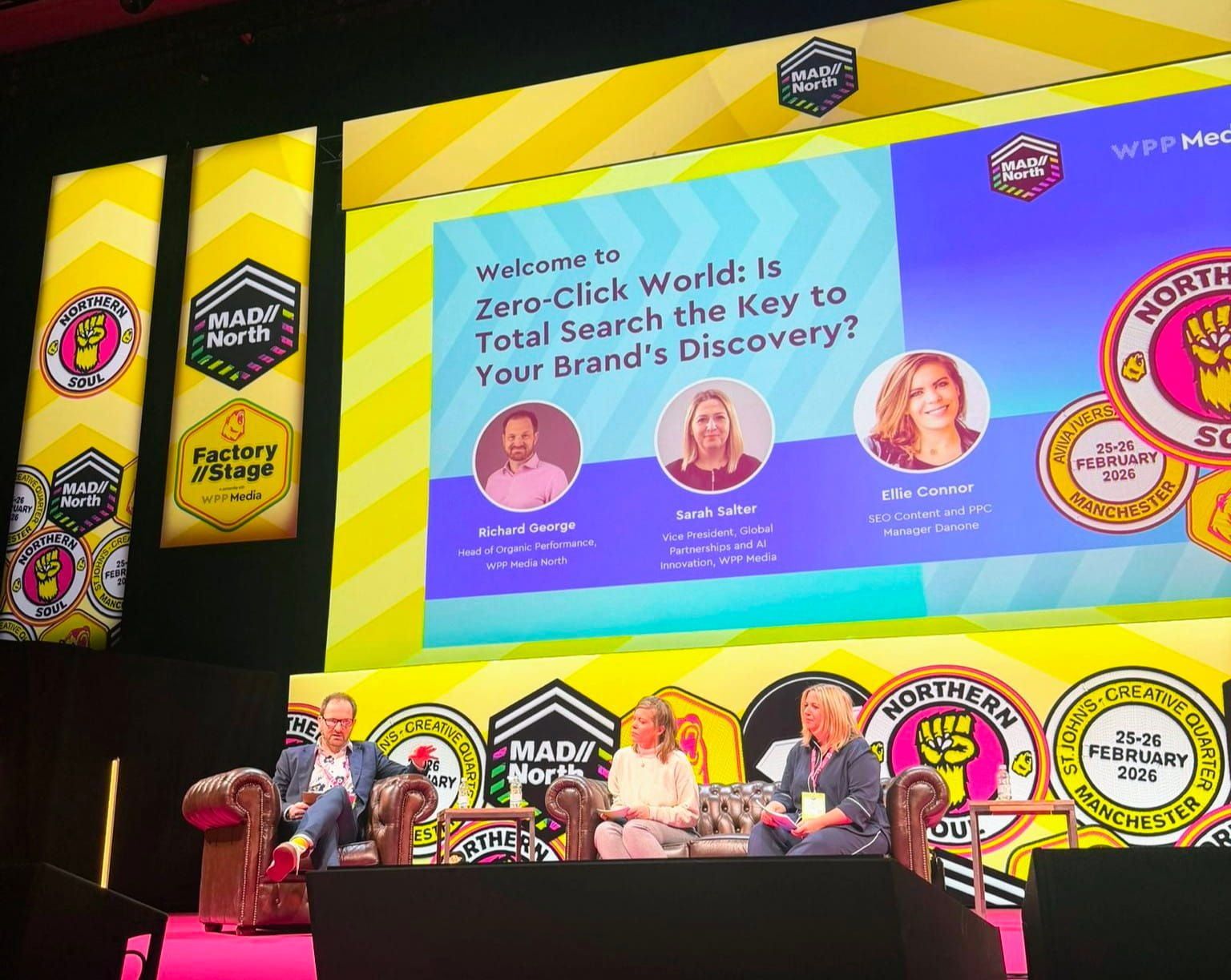
A new agency mandate, what WPP Media aptly calls Strategic AI Guidance. The value isn't operating the machine; it's setting its goals, feeding it the best data, and governing how brands appear.
Authenticity as a differentiator, with SynthID-style provenance becoming a deliberate brand choice rather than a compliance afterthought.
The brands that win won't be the ones that resist this. They'll be the ones who decide, deliberately, what they want the AI to say about them, and then build the evidence to make it true.
Let's talk about your AI-visibility gap
This is the shift I spend my days helping leadership teams navigate. If you're a CMO or marketing director wondering whether your brand is visible to the agents now mediating discovery, that's exactly the conversation I want to have.
Tell me in the comments: are you still measuring clicks, or have you started measuring your share of the answer? I read and reply to every one.